Teaching Games
Bringing Data-Driven Pedagogy to the Classroom
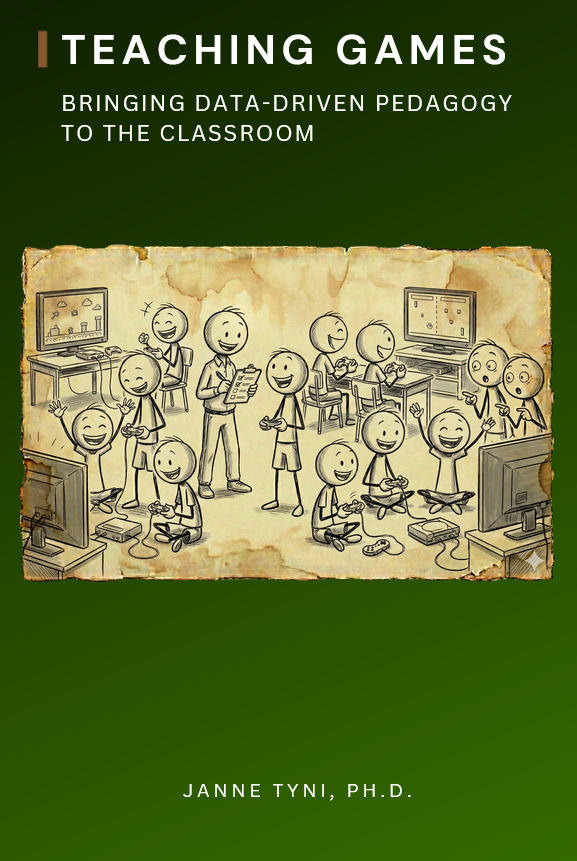
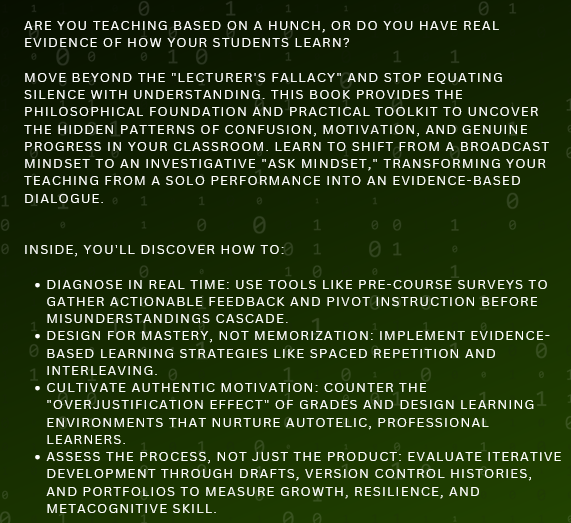
Teaching Games advocates for replacing traditional, opaque teaching cultures with empirical, data-driven pedagogy. It challenges the "Lecturer’s Fallacy"—the mistake of equating student silence with understanding—and proposes agile, evidence-based methods for managing the classroom.
This book is not just an argument for modernization; it is a practical guide for educators in technical and creative fields to close the loop on student learning through radical transparency and curricular iteration.
Key Ideas
- The Ask Mindset: Shifting from a "broadcast" orientation (delivering content) to an "investigative" orientation (analyzing what students actually understood).
- Zero-Grade Rule: Formative feedback instruments must never be graded for content to ensure students feel safe disclosing their actual confusion.
- The Minimalist Toolkit: Using reproducible scripted workflows (like RStudio) and AI clustering to manage feedback without manual data entry errors.
- Authentic Assessment: Designing tasks that mirror professional reality and resist AI "shortcuts" by rewarding iterative process and persistence.
- Evidence-Based Retention: Moving students away from ineffective "cramming" and toward spaced repetition, interleaving, and generative learning.
Who is this book for?
- Educators and Lecturers: Particularly those in technical or creative fields looking to improve student engagement and mastery.
- Institutional Leaders: Those interested in "closing the loop" on student learning through radical transparency and curricular iteration.
- Teaching Assistants: Individuals looking for actionable methods to handle large volumes of qualitative student feedback efficiently.
Book Covers
Front Cover
Back Cover
About the Author

Janne Tyni, Ph.D.
Janne is a games user researcher and educator deeply passionate about player-centered design and data-driven pedagogy.